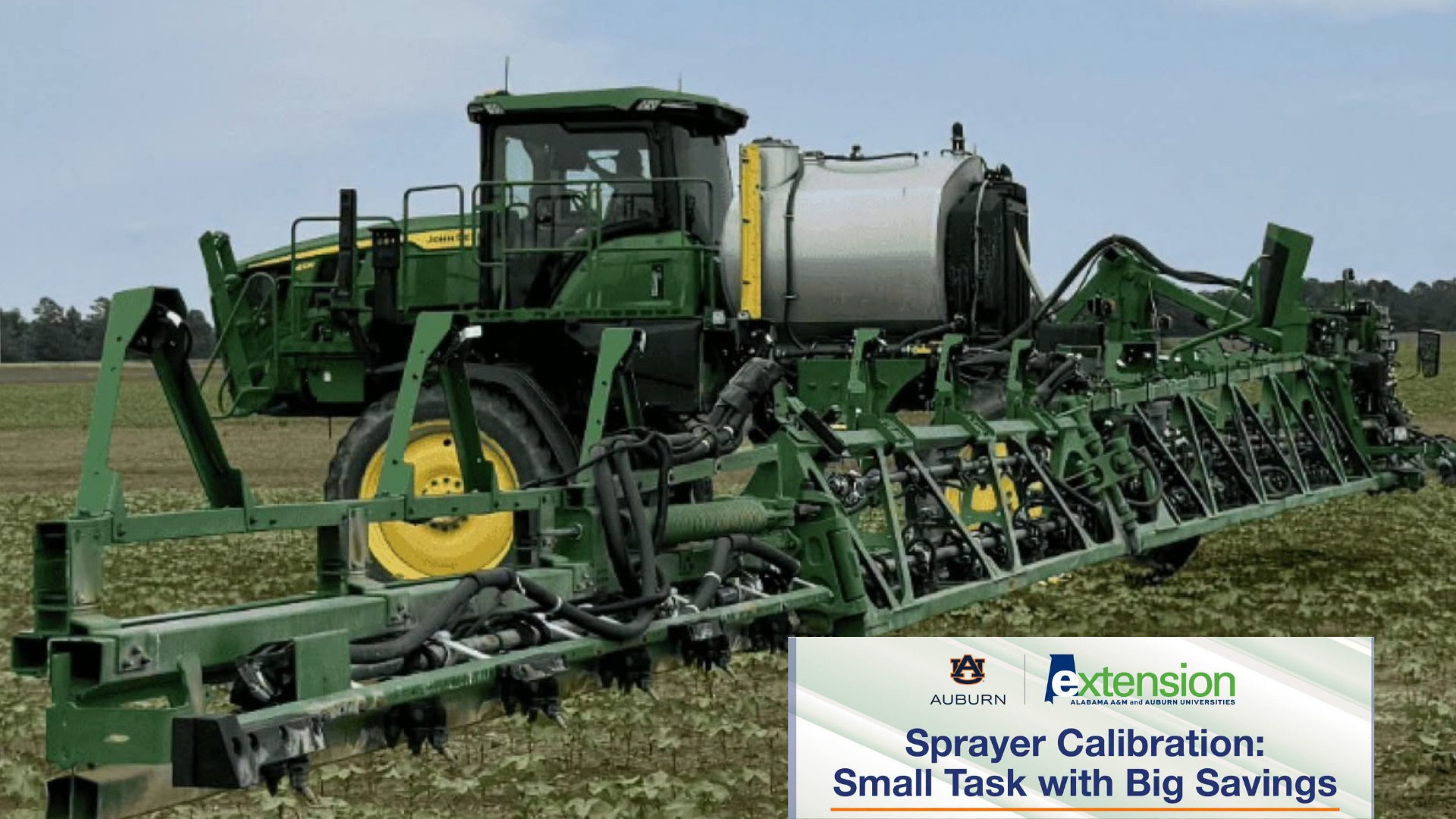
AUBURN UNIVERSITY, Ala. (WDNews) — A small task could lead to big savings for Alabama farmers using agricultural sprayers.
According to the Alabama Cooperative Extension System, proper sprayer calibration can improve application accuracy, reduce input costs and help farmers get more from precision agriculture.
Simer Virk, an Alabama Extension specialist at Auburn University, said calibration involves measuring the individual flow rate of nozzles on a boom sprayer. Without proper calibration, farmers can under- or overapply pesticides, wasting time and driving up costs.
“It seems like such a small, menial task,” Virk said. “But we are talking about thousands of dollars that growers can save just by effectively calibrating their sprayers properly.”
Virk encourages growers to calibrate their sprayers before their first pesticide applications and again as needed throughout the season.
“During the season, we are likely putting out different chemicals at different rates, so you definitely need to recalibrate for accurate applications,” Virk said. “Whenever you are changing your operational parameters, then I definitely recommend recalibrating.”
Those changes can include application rate, nozzle type and sprayer speed. Properly calibrated spray booms provide more uniform coverage while reducing gaps and streaking.
Alabama Extension said growers should check several nozzles during calibration because normal wear can cause flow rates to vary. Virk recommends checking at least three to five nozzles on each boom section.
“Our typical field sprayer booms can run anywhere from 60 to 100 feet and have roughly 40 to 70 nozzles,” Virk said. “Catching flow rates from multiple nozzles can be time consuming, but there are tools like the SpotOn meter that make this task easier than the traditional method.”
Virk also cautioned farmers against relying only on a sprayer’s in-cab monitor.
“I know it’s easier to trust the monitor alone in the cab,” Virk said. “That may not be telling you the whole story, though, as it is not accounting for worn-out tips or plugs and sensors still go out of calibration sometimes.”
The research also has a Wiregrass connection. Virk and his team conduct sprayer testing at the Wiregrass Research and Extension Center and the E.V. Smith Research Center. Tests include examining nozzle types, application uniformity and advanced sprayer technologies.
Virk said newer technology can help growers make more precise applications, but physical calibration remains important to ensure equipment is working properly.
With chemical costs rising, Alabama Extension said accurate applications can help growers reduce waste and save money.
For more information about proper sprayer calibration, tools and tips, visit Alabama Extension’s Sprayer Calibration guide:
https://www.aces.edu/blog/topics/farming/sprayer-calibration-small-task-with-big-savings
 Image Source – Alabama Extension